Before the Law Stands a Doorkeeper, 1985
This 1985 show explored the intimacy of narratives found in Americana.It included a mural size painting on wood that married the style of Pennsylvania Dutch barn paintings with Kafka’s story, Before the Law Stands a Doorkeeper.The show also included paintings which utilized the folklore technique of “reverse painting”. However, this technique was reinvented by replacing the traditional glass canvas with a metal wire mesh canvas. The resulting effect challenged the conventional foreground/background order of painting on canvas.
Before the Law Stands a Doorkeeper, 1985
This 1985 show explored the intimacy of narratives found in Americana.It included a mural size painting on wood that married the style of Pennsylvania Dutch barn paintings with Kafka’s story, Before the Law Stands a Doorkeeper.The show also included paintings which utilized the folklore technique of “reverse painting”. However, this technique was reinvented by replacing the traditional glass canvas with a metal wire mesh canvas. The resulting effect challenged the conventional foreground/background order of painting on canvas.
Izhar Patkin
Izhar Patkin
Izhar Patkin
Veiled Threats, 1999 - Current
A series inspired by the poems of Agha Shahid Ali
Rooms of wall size paintings in ink on pleated illusion (tulle curtains). 14 x 22 x 28 in. each
Agha Shahid Ali and Izhar Patkin started the collaboration on “Veiled Threats” in 1999
In this project, each of Patkin’s veil rooms corresponds to one of Shahid’s poems.
Veiled Threats, 1999 - Current
A series inspired by the poems of Agha Shahid Ali
Rooms of wall size paintings in ink on pleated illusion (tulle curtains). 14 x 22 x 28 in. each
Agha Shahid Ali and Izhar Patkin started the collaboration on “Veiled Threats” in 1999
In this project, each of Patkin’s veil rooms corresponds to one of Shahid’s poems.
Veiled Threats, 1999 - Current
A series inspired by the poems of Agha Shahid Ali
Rooms of wall size paintings in ink on pleated illusion (tulle curtains). 14 x 22 x 28 in. each
Agha Shahid Ali and Izhar Patkin started the collaboration on “Veiled Threats” in 1999
In this project, each of Patkin’s veil rooms corresponds to one of Shahid’s poems.
Veiled Threats, 1999 - Current
A series inspired by the poems of Agha Shahid Ali
Rooms of wall size paintings in ink on pleated illusion (tulle curtains). 14 x 22 x 28 in. each
Agha Shahid Ali and Izhar Patkin started the collaboration on “Veiled Threats” in 1999
In this project, each of Patkin’s veil rooms corresponds to one of Shahid’s poems.
Veiled Threats, 1999 - Current
A series inspired by the poems of Agha Shahid Ali
Rooms of wall size paintings in ink on pleated illusion (tulle curtains). 14 x 22 x 28 in. each
Agha Shahid Ali and Izhar Patkin started the collaboration on “Veiled Threats” in 1999
In this project, each of Patkin’s veil rooms corresponds to one of Shahid’s poems.
Veiled Threats, 1999 - Current
A series inspired by the poems of Agha Shahid Ali
Rooms of wall size paintings in ink on pleated illusion (tulle curtains). 14 x 22 x 28 in. each
Agha Shahid Ali and Izhar Patkin started the collaboration on “Veiled Threats” in 1999
In this project, each of Patkin’s veil rooms corresponds to one of Shahid’s poems.


Don Quioxte Segunda Parte, 1987
Anodized cast aluminum
Life size 92 x 75 x 40 in (edition 5)
(catalog)


Don Quixote 'reading' The Adventures of Don Quijote Part II,
while looking in a mirror.

Going East by Going West
Text by Pedro Cuperman
book published by Carla Sozzani Editore, 1989
I was afraid to go, but glad to leave... no pumpernickel, such red and green drinks in America. All I knew was Buster Keaton and Henry Ford. Josef Albers, the first Bauhausian to reach America.
ANTlPODES I. “I entered upon the sea sailing, and so have I continued to this day. That art of navigation inclines him who follows it to want to know the secrets of this world." Thus wrote Colum- bus, the navigator; a Renaissance man, to the King and Queen of Spain declaring his qualifications for remodelling the shape of the globe, so he may place "lands of the Ocean Sea in their proper positions under their bearings." As for the Journey, says Samuel Morison in Admiral of the Ocean Sea, A life of Chris- topher Columbus (1942) he gave "only three latitudes - all wrong - and no longitude for the entire voyage." Later on, pressed by the stern look of his shipmates, he was masking the traces of his real Journey of discovery offering a "reduced or phony one for the crew, so that they would not complain of being taken so far from home." "If you wish to hide some -thing,” says Durrell quoting an Arabic proverb, “hide it in the sun’s eye.” A better idea, suggests Poe, could be to live it before everyone’s eyes.
II. One wonders why would Samuel Morison have chosen an epigraph of Don Quixote as a point of departure for his book on Co1umbus. What is the resemblance? The clue, maybe, is the word antipode,' situated at the opposite side ... of earth.
III. America as discovery is the opposition between project and projection. By the time navigation became a way of discovery, Leon Battista Alberti de Piaura (1435), was advising artists to seek truth in nature, and to translate what they saw in terms of narrative, because he who wishes to express life must emphasize motion. In his Trattato (1498) Leonardo further explicates that as an intense sensorial act, a personal experience of the senses, "mother of all certainty," Renaissance vision had its own illusions, embracing at times what is, in what is not. Open eyes are not all vigil nor all the vigil, wrote the Argentine poet Macedonio Fernandez.
IV. Nature, fantasy, picaresque, Art, America is the search for the other shore, the antipode, Columbus, like Cervantes, interrogates the commonplace, pointing to what educated man of his time would automatically negate. PROCES VISUEL V. After Columbus returned, and after the newly found lands were established as the New World (Columbus himself used the enigmatic otro mundo, “other world”), iconography mostly In the Low Countries began a sort of proces visuel. Hugh Honour’s The European Vision of America (1975) came to me as a happy surprise. Never before has Europe extended the range of sensual imagination to embrace, in one gesture, such anti- podes as exotism and science, reason and dream (at times dreams of reason that turned out to produce monsters).
THE LANGUAGE VI. America's early iconography is the visual transposition of written accounts. Most of the times the source is Peter Martyr, a very singular man fighting a monster he could not identify, one eye in the Renaissance, the other in the Baroque. Pietro Martire d'Anghiera, Italian, Milanese, European. Pedro Mar- tir, Chaplain to Queen Isabella, lecturer at Salamanca, Histor- ian. Transcriber of Columbus's first projects, of Western Man's projections. By 1494 he had begun writing Decades de Orbe Novo (Decades oj the New World), the first account of the Journey and its aftermath. Published in 1516, it was a rather melancholic text about Europe's ways of invading or embra- cing the New World. VII. The New World in the first iconographic renderings is a continuous succession of time zones, not yet Newtonian but no longer Aristotelian. The first illustrations were intended for naturalists, as the notable engraving Hortus Floridus by the Dutch artist Crispinus Passeus clearly demonstrates. Buyt the tip of the iceberg gives mixed signals. Looking at the arma- dillo that illustrates the English translation of Nicolas Monar- des’s book on West Indies medicines, Primera y segunda y tercera partes de la historia medicinal de las cosas que se traen denuestras Indias Occidentales que siruen en medicina (1574): Why would a Book on medicine be translated as early as 1577 and under the Title Joyfull Newees out of the Newe Founde Worlde? What could be so Joyful about that news?
VIII. T. Todorov, in The Conquest of America (1984), suggests that early New World interpretation responds to Europe's own dream, transforming everything for its own reassuring sake. To see is to confirm, to draw from desire. Yet, a question arises when it comes to anthropomorphic illustrations. Those first iconographic signs, are they fancy deceptions? Decep- tions are excuses before a given audience, or before oneself. Why not assume a predeceptive stage, an imaginary First encounter with something entirely new, where the lack of excuses makes a visual (real) encounter possible? America as a sensual encounter? (By the Fifties, American litera- ture, Kerouac, travelled for a while along this road lulled Eastern phosphorescence, and as was the case with Columbus, the East was a distant dream, a mirage, a figure of speech, perhaps).
IX. Some meticulous illustrations made in Brazil in 1644 by Frans Post and Albert Eckhout were the “first ethnogra- phically valid portraits to be made of any Amerindians.” Later, those portraits acquired a second life. Pop Art avant la lettre, evolving from scientific recordings to nostalgia, very much in the way Pop artists restate scale (in very Proustian terms, I think; Pop Art has chosen size rather then smell, but in both cases "lost time" - that is, lived reality - is the true subject). Weavers of Gobelins quickly discovered a fascinating equa- tion between the craft of scientific records and Art, as Pop Art did, and what began as visual transcription eventually became exotica, joyful evocations of tropical luxuriance. We can go even further, and assume that once this equation takes place a third new face is engendered, an iconography of se1f-recogni- tion that points no more to America as Discovery but to Americanerie, to use Hugh Honour's term. A recognition of America as North, USA America. The New World, at the end of the 16th century began as an iconographical cliché named America, enacted most of the times by a naked female- gluttonous, man-devouring in the engraving of Phillip Galle, or by a "bare bosomed indian woman who directs her arrows at the falling figures of paganism." Eventually the transform- ations of this icon relied on other kind of certainties, as was the case with Lady Liberty, America's ancestral lady rising like Lazurus on the East River to celebrate her own resurrection.
IXa. Another aspect of the same thing is the manner in which a contemporary artist, say Warhol concerns himself with otherness. Being in North America, his sense of otherness is somehow compulsive. One wonders if what critics call War- hol’s way of criticizing society, of “undermining the concept of genius,” is not simply an arrow directed at tan imaginary, obsessively incriminating critic, his media mirror, rather than at society. For this specially calculated irony is one of the chief purposes of those panels, or frames, that embrace a single motive, reiterated like a phrase, in the tradition of a rose is a rose is a rose.
X. “I am excited about seeing things,” says Roy Lichtenstein “and I am interested in the way I think other people saw things. I suppose ‘seeing’ at its most profound level may be synonymous with form, or rather form is the result of unified seeing.” We still look for what must have been the first encounter, its silent content: a sensual otherness emerging from nowhere, an enigmatic figure, half-ornament, half-jewel, printed or inscribed like a biological print of a Sun-God in the living flesh. Never mind that later the only accounted experi- ence is the language of censorship. According to Peter Martyr, men wearing rings and precious stones became objectionable, for “it is considered effeminate to decorate one’s self for in this wise.”
XI. Pressed by some forgotten need, the artist transposes his first impressions according to iconographic formulas of the time. The other ceases to be there (that is, somebody obsti- nately opaque confronting us, as Sartre would have it) in order to become allegory: a metaphysical trophy implanted in the soul of Western man, by then already showing signs of disintegration. (This is Richard Eden’s version of Peter Martyr's version, of Columbus speaking to an old respectable, “although naked," Taino, one of America's extinct People: “I was sent into those countries by the Christian king of Spaine... specially to subdue and punish the Canibales, and such other mischievous people, and to defend innocents against the violence of evill dooers..." One cannot help notice, even in the Elizabethan prose of 1555, the future voice of Spain's Golden Age, of Don Quixote).
XII. Speaking about iconography, where was Renaissance nature, after all? About this we should say what Carlos Fuentes said about Mexico's ancient Gods: "they do not illus- trate nature, they illustrate what nature could never be: the other, a separate reality."
BACHELARD XIII. Where Aztec pictography is language that refers to recurrent time, Spain sees only ornament; at times it was America curiosa, later America exotica: gems and pearls and ani- mal-and human grotesqueries (Priscilla Muller, jewels of Spain: 1500-1800, 1972). Europe looked for its primordial Self in this rippling translucent world. America was water; narcissic water; as Bachelard suggests. They came in seqarch of the other, play- ing with water as if a mirror . . . By the 17th century Baroque Art saw itself in that mirror. Don Quixote is the evidence: art as a quest for reality mired in desperate reversals and oxymoron’s, expanding the outlines of reason, the healing aspects of rhetoric. Philosophy (Descartes) in the meantime embraced methodic doubt as a deliberate search for first certainties.
XIV. In theoretical Reason there is nothing that justifies the existence of the other, says Kant. Reason, is unable to justify even hope. Five hundred years after Columbus's journey, are we still looking for that other shore? Yes and no. The Mirror of the 17th century is shining in some of Lichtenstein's paint- ings, it hangs intact in Pirandello's plays, or broken in the spi- dery sculptures of Nancy Graves, in Italo Calvino's cosmicomic universe… No certitude can be offered as to the ontological status, of where it is or what exactly is the outside of those mirrors. It may well be our rehearsed desires ("Me standing twenty years later," says Andy Warhol, "and still with a Camp- bell's soup thing"), forfeited islands of a yet undiscovered other shore. But they are really ours. Velazquez's world is closer to us than most of the Gas Stations of Hyperrealism no matter how faithfully they prove or disprove the banality of observation. And this is more then a stylistic problem, since it has to do with modes of valuing metaphors: viable if conceivable, if reversible. Imagination models Imagination.
XV. The whole western quadrant of 180 degrees lay open to Columbus, says Samuel Morison . . . Why not try sailing West, to Japan, China and India? West because destination is East. Perhaps this is the appropriate moment to recall Morison’s analogy with Don Quixote, and to introduce one of its pas- sionate transfigurations, Izhar Patkin's Don Quijote Segunda Parte. Surely there is a new angle to all this; the book is the new angle. What could be a better illustration of the genera- tion of texts: a book about a sculpture suggested by a book. And this obsessive Baroquism gives the work a curious actual- ity. Don Quixote, a concrete idea, paraphrased by Don Qui- jote, a sculpture, hunting for the attainless. The compulsion of books, which for Cervantes was genuine, will be the theme and technique of this Don Quijote. His Baroque body, design upon design, seems to be rising roped by the sheer weight of his books.
THE MEASURE OF ALL THINGS XVI. "If there is something in common among the characters of the Spanish Golden Age," wrote Alexander Cioranescu - (Le Masque et le visage) "it is the fervor with which they search themselves in their adventures, according to an absurd wish to make from their biography the exact duplicate of the inner reality, Consequently, the mirror is a multiple one. It looks for the inner soul. But that soul is external, theatrical, the World of a Stage or the world upsidedown." In its own way, Don Qui- jote Segunda Parte re-presents this main idea of the Spanish Golden Age: Art in search for an external biography. This, I think, is the proposition advanced by Izhar Parkin's work. A lesson in metaphor made possible by a reference to the stran- gest character in art’s history. No ordinary madman is Cervan- tes’s Don Quixote. Patkin’s Don Quijote hangs rather for- lornly from his saddle. A terrorized look, a blushful deceptive gesture; a new, self-questioning gesture seen in a mirror: the gravitational field of Baroque Art.
I said metaphor; because the work refers to the second part Of the famous book, to be more precise, to the chapters where Don Quixote and Sancho discuss their own role as characters In the novel, a fantastic event, the key to the metaphysical uncertainties of the 17th century. The moment has a kind of magic tension and it is reflected in Don Quijote's face. Patkin has placed before his eyes a book and a mirror. What are those luciferian eyes looking for? Is it Art's self consciousness, as old Rosenberg would say referring to Pop Art? Maybe they are after the true biography of the Quixote, the Quixote of fiction, where a new one, less fragile but not less somber, may eventually recognize itself. Patkin's search is a tension be- tween these two alternatives. Through the work we relate to the art of our time, and with equal intensity, to the themes of that Baroque world of Don Quixote de 1a Mancha.
To read a book or to read oneself in the mirror. For a brief moment narcissism may seem the lyrical event. But this is not a patient in need to recover. Don Quijote looks at himself in the mirror and, like Protagoras, who thinks that "man is the measure of all things, of things that are, and of things that are not” (measure not meaning in the romantic sense), sees his pos- sible Self revealed by the mirror of art.
In a century dominated by appearances, as Guarini used to say, the artist faces power by imposing his own measures of things. He transfigures life by transforming language. That’s how Baroque Art could create a fantastic world through ver-0 bal color and visual words. The word “technique” should be qualified. At times the technique is genre, say Painting; but color may well follow principles borrowed from music: tone is not just a metaphor, for it may well structure the search for a given resonance.
Theme and technique go hand in hand. They revert into each other. Bernini looks for that resonance, and so does Pat- kin. Don Quijote Segunda Parte finds its true form in the dia- logue of artistic languages. For a brief moment we see the figu- rine, the chinoiserie, maybe the language of nostalgia. In the way color is used we may rediscover the structural key of a tactile exchange. Somehow it brings us closer to the work... Yes, you may touch it. All of Patkin's work is pervaded by this proposi- tion. Tactile desire as an illustration of a way of being and see- ing. Accessible erotism, evidently visible. To see is to touch. Nothing is superfluous for a popular mise en scene,
In one of Patkin's shows - The Perfect Existence in The Rose Garden – the dominant form was the oxymoron: Hortus exclu- sus, a closed garden open to the public. Here, the rule is anti- thesis. Symbolic as well as material antithesis. The struggle of the figures to coalesce into a composite imagery is here the most invoked experience. To place Don Quijote on his saddle is obvious, to make him ride in the diagonal of the Baroque is a structural conflict. Distance that may well convey a renewed imagery, a sort of historical violence.
The procedure acquires new meanings: a spectrum of refer- ences that, while not alien to some Pop motives, became a real journey of discovery. What makes this piece curious is to see how it all operates at the level of production: the place- ment of the roses, the titles of the books, the circular mirror, all of it makes for a meander of representation dominated by the sense of material reflection; a mirror, an oceanic event.
This Don Quijote Segunda Parte makes use of the character Don Quixote. And parody alone is not the structure of such relationship. Don Quixote would disappear otherwise. But Patkin haunts him, he wants to make him his own, to truly appropriate him. They belong to each other. What could be a better illustration than this way of addressing the past as the other; nourished by a dormant, covered (or covert) energy in the past, the true meaning of what Parody should be: a rehabilitation, a reawakening. And it is that use of theme and technique that distinguishes Don Quijote from a post-modern appropriation. For post-modernists, appropriation is merely ~ frame, they don't use, they don't touch, they don't penetrate the work they appropriate. At best, they mention it as one mentions wine or poison while analyzing a poem of Baude laire, at distance and without risk.
In one of the meanings of the mirror, Art is at issue, Art being conscious about itself. Patkin's sculpture is somehow a compendium of Art references, as in a mirror one may see the struggles of contemporary art. But as mentioned before, it is also a search for Don Quixote, a Quixote which perhaps could never be conceived by the conventional iconography of the famous character. Most of Don Quixote's illustrations have no happy endings. The motive seems to be the animated skeleton, the penitential clown; or at best, the prolongation for 17th century melancholy into the present (“Not only has there been a steady sentimentalization of the Don and his sidekick,
Sancho Panza - sweet charmingly befuddled Don Quixote! comic Sancho, so picturesquely a level headed peasant! – but a displacement as well as of the text by its illustrators, specially Gustave Dore, Honore Daumier (and nowadays Picasso and Dali), its celebrators, imitators, dramatizers, and users of the word quixotic, which means anything you want it to mean”. G. Davenport, Foreword to Nabokov's, Lectures on Don Quixote, Harcourt Brace Jovanovich, NY, 1983, p. xiv).
Don Quijote Segunda Parte is not the same character, evi- dently. And we should thank Patkin for not having indulged in that kind of feverish appropriation. As perhaps a novel might do, he went on searching. Free from the needs of visu- alizing Cervantes's text, Patkin searched for his own text through the language of Art. And what might appear to be arbitrary may well prove to be the opposite. Compared with the horses of San Marco, which are almost ready to fly, the horse in Don Quijote Segunda Parte gives the impression of being frozen in his obstinate self-assurance, Besides, he looks proportionally diminished in size. This is not Rocinante, true; but neither is it the heraldic horse of the equestrian tradition. Size is here a concrete idea. Again, technique and symbolic play come together and translate into a greater consciousness. Don Quijote, Patkin's Don Quijote, seems distant. He has outgrown his horse, in a movement that removes him from the saddle, suspended in a feminine rapture, as if ready t leave . . . Nabokov, at the end of his reading of Don Quixote, writes: “We are confronted by an interesting phenomenon: a literary hero losing gradually contact with the book that borre him; leaving his fatherland, leaving his creator’s desk and roaming space after roaming Spain.”
Don Quijote Segunda Parte, like his model, points to a revela- tion: the solitary encounter of a Baroque character with one of his masks. Patkin certainly weakens the reference to the orig- inal text, and consequently to the conventional meaning of the work. But not to the real meaning. This Don Quijote is the contemporary version of a character that simultaneously reads a book and looks into a mirror with a nocturnal sight, Art's feminine eye, according to Jung. Perhaps Quixote's last metamorphosis, the one Cervantes did not dare to write. A brave new Don Quijote not in love with himself as the mirror may suggest, but with the measure of all things... searching, for this new metamorphosis.
The malign enchanter who doth persecute me hath clouds and cataracts upon my eyes, and for them and them alone hath transformed thy peerless beauty into the face of a lowly peasant maid; and I can only hope thee has not likewise changed my face into that of some monster by way of rendering it abhorrent in thy sight. But for all of that, hesitate not to gaze upon me tenderly and lovingly, beholding in this act of submission as I kneel before thee a tribute to thy metamorphosed beauty from this humbly worshiping heart of mine.
In the first part of this century, Brecht believed in the de- struction of illusion and this in turn meant the shattering of the spectacle, of the play, of the semantic field that surrounds character, and finally the shattering of the space of representa- tion. That is why Brecht recommended the abandoning of the so-called fourth wall, the imaginary glass of the Italian theater that separated audience and stage. For Brecht, as for some avant-garde artists, this separation was almost mind wounding. Now, this sort of luciferian act, this theatrical space made in heaven, or in hell, this labyrinth of ironies was the treasure box of the Baroque. A celebration of riddles, of that double scene that Hamlet and Don Quixote recreated on the ground of madness, but a madness uncontaminated by Brecht's idea of alienation. "The spectacle of the 17th century,” says Jean Rousset, "presents itself under the disguise of an enterprise of systematic and collective madness... as if this cen- tury would love simultaneously the magic illusion and its disappearance. The essence of the dream is the evanescent.” Cervantes's Don Quixote was born under this evanescence, Patkin's under a less evanescent one. The truth, if there is is to be found in our own mirror. As for the Don Quixote of la Mancha, it was good Art, a good life, and he died in bed.


Detail Views


Parts Dissembled




“Horses and people are not the same. Horses don’t get up in the morning with the idea in mind that today they are going to be a better horse than they were yesterday. It’s the rider’s idea that today the horse will run faster or leap higher. The horse is only along for the ride. There’s probably an angle from which the horse is infinitely the superior being. There’s also an angle from which the difference between man and horse looks like no more than man’s vain illusion, from which it appears that we fool ourselves in supposing we are not the ridden ones, that our hope is only someone else’s saddle. This sculpture does not present the situation from either of these angles. Here, the condition of reaching each moment toward an ideal is presented with the utmost sympathy and respect. So what if it’s just a condition? So what if ideals are everywhere tainted and so compromised that even to gallop along the beach at dawn is to embarrass a sun forbidden to do anything but set? Of that’s the loss of meaning that occurs when an ideal loses its connection to a life, then it’s time to call for a mirror and demand that is show us the face of hope.”
Herbert Muschamp – model for sculpture of Don Q Part II


Installation at Holly Solomon Gallery
Installation at Venice Bienale


At the Ludlow Street Gallery


Installation at Ringling Museum


Installation at Corso Como, Milan


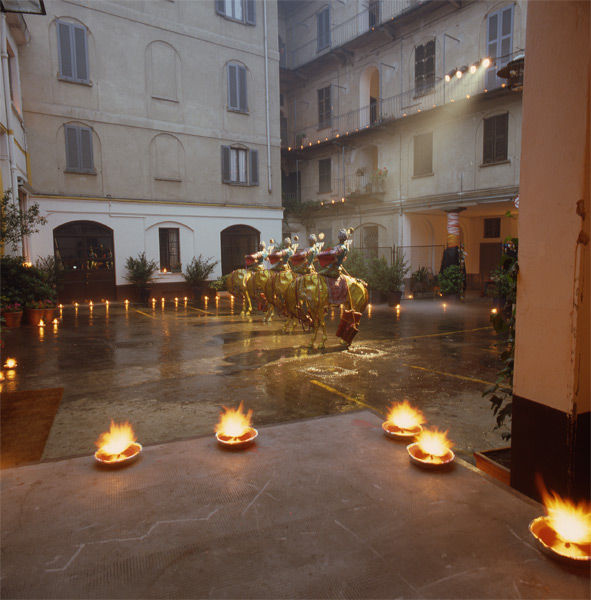


Installation at Arles


Original sketch on paper